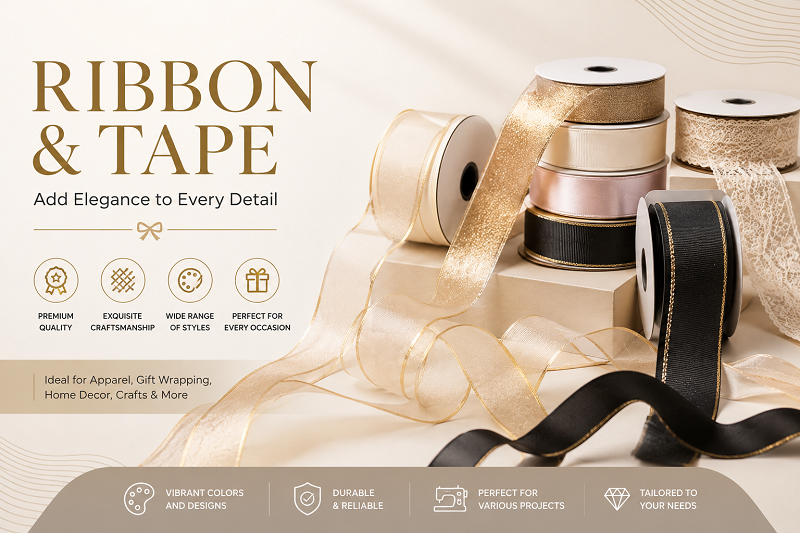
- High-quality Ribbon & Tape improves product appearance because it adds clean edges, stable color, and consistent texture.
- Decorative Ribbon supports branding because it makes garments, gifts, and retail packs look more refined and memorable.
- Polyester Ribbon Tape performs well in apparel because it offers durability, flexibility, and resistance to daily handling.
- Packaging Ribbon increases perceived value because it helps products feel finished, premium, and ready for presentation.
High-quality Ribbon & Tape improves garment and packaging applications by making products stronger, neater, and more attractive. In garments, it reinforces seams, labels, trims, waistlines, and decorative details while helping accessories stay comfortable and durable. In packaging, it creates a polished presentation, supports brand identity, and improves the customer’s first impression. Because premium ribbon and tape products offer stable color, smooth texture, and reliable tensile performance, therefore manufacturers can reduce defects and deliver more consistent finished goods. This is especially important for fashion brands, gift suppliers, packaging companies, and garment accessory buyers that need dependable materials.
For apparel production, Garment Accessories must balance style with function. A ribbon that looks beautiful but frays easily can affect product quality, while a strong tape that feels rough can reduce comfort. Polyester Ribbon Tape is widely used because it combines strength, softness, and design flexibility. It can be applied to sportswear, casualwear, uniforms, children’s clothing, bags, hats, and textile labels. Because polyester materials resist stretching, abrasion, and frequent handling, therefore they help garments maintain a cleaner appearance over long-term use.
In packaging, Decorative Ribbon and Packaging Ribbon do more than wrap a box. They communicate care, value, and brand positioning. A smooth satin ribbon can suggest elegance, while a printed ribbon can reinforce a company logo or seasonal campaign. For retail packaging, wedding products, cosmetics, gift boxes, and promotional sets, the right ribbon can turn a simple package into a premium experience.
Businesses sourcing Ribbon & Tape should consider material consistency, color accuracy, width stability, finishing quality, and customization options. Swell Industry provides a broad range of ribbon, tape, and garment accessory solutions for different commercial uses. You can explore available products through the products page, learn more about the company on the about page, or request support through the contact page.
Part 2: Market Overview, Statistics, and Industry Data
The Ribbon & Tape market is expanding as apparel brands, gift-packaging suppliers, and e-commerce sellers demand materials that are decorative, durable, and compatible with automated production. According to Grand View Research, the global adhesive tapes market was valued at USD 80.2 billion in 2022, showing how tape-based materials have become essential across packaging, logistics, textiles, and consumer goods. In parallel, Statista reported that global retail e-commerce sales reached approximately USD 5.8 trillion in 2023, increasing demand for branded Packaging Ribbon, sealing tape, and decorative finishing materials.
Because online orders must survive storage, transport, and last-mile handling, therefore packaging suppliers increasingly choose stronger ribbon and tape materials that combine visual appeal with tensile performance. This trend benefits Polyester Ribbon Tape in particular, since polyester offers good color retention, abrasion resistance, and dimensional stability. For garment manufacturers, Decorative Ribbon and other Garment Accessories are also gaining value because they help differentiate mass-produced clothing without requiring major pattern or fabric changes.
| Material Type | Main Strength | Typical Application | Market Advantage |
|---|---|---|---|
| Polyester Ribbon Tape | It provides high durability and stable color performance. | It is used for garment trims, brand labels, gift bows, and premium packaging. | It supports both decorative and functional requirements. |
| Cotton Ribbon | It provides a soft touch and natural appearance. | It is used for boutique apparel, crafts, and eco-style packaging. | It appeals to brands emphasizing texture and a natural look. |
| Nylon Tape | It provides excellent strength and abrasion resistance. | It is used for straps, binding, outdoor goods, and technical garment parts. | It performs well in high-stress applications. |
Industry data also shows that material choice is increasingly linked to sustainability and compliance. The Textile Exchange Materials Market Report identifies polyester as the most widely produced fiber globally, which explains its broad availability for ribbon and tape conversion. Meanwhile, the U.S. Environmental Protection Agency reported that containers and packaging generated 82.2 million tons of municipal solid waste in 2018, pushing brands to evaluate lighter, recyclable, or longer-lasting packaging components.
- Brands are selecting Decorative Ribbon that improves shelf presentation while maintaining consistent color and texture across production batches.
- Manufacturers are using Polyester Ribbon Tape because it performs reliably during sewing, folding, heat processing, and packaging assembly.
- Because garment and packaging buyers need both appearance and reliability, therefore high-quality Ribbon & Tape products are becoming strategic components rather than simple accessories.
Part 3: Key Requirements, Standards, and Regulations
For manufacturers and buyers, high-quality Ribbon & Tape products must satisfy more than appearance requirements. In garment and packaging applications, materials such as Decorative Ribbon, Polyester Ribbon Tape, Packaging Ribbon, and other Garment Accessories are often evaluated for safety, durability, chemical content, labeling accuracy, and end-use performance.
Key international compliance references may include UL safety standards, ETL certification by Intertek, CE requirements for products sold in the European market, and the IECEE CB Scheme for electrical and safety-related product acceptance. While not every ribbon is an electrical component, trims used near lighting, heated displays, smart packaging, or appliance accessories may require additional verification. Environmental and indoor air considerations may also reference guidance from ASHRAE, especially where packaging materials are stored in controlled commercial environments.
| Requirement Area | Typical Standard or Mark | Relevance to Ribbon & Tape Products |
|---|---|---|
| Flammability | UL, CE-related safety assessments | Important for garment trims, display packaging, and ribbons near heat sources. |
| Chemical Safety | REACH, RoHS, OEKO-TEX where applicable | Controls restricted dyes, heavy metals, phthalates, and harmful finishes. |
| Product Safety Testing | ETL, Intertek testing programs | Supports third-party verification for retail and export requirements. |
| International Acceptance | CB Scheme, CE documentation | Helps reduce repeated testing when supplying multiple markets. |
Common compliance challenges include inconsistent dye lots, undocumented coatings, unclear fiber composition, adhesive migration, and missing test reports from upstream suppliers. Because Polyester Ribbon Tape may be exposed to washing, heat pressing, friction, and long-term storage, therefore its colorfastness, shrinkage, and tensile strength must be verified before bulk production.
For Packaging Ribbon, brand owners should also check recyclability claims, ink safety, and odor control. Because Decorative Ribbon can come into direct contact with apparel, gift foods, cosmetics, or children’s products, therefore suppliers should maintain traceable raw-material records, updated certificates, and batch-level quality inspections. A reliable compliance program reduces recall risk, supports customs clearance, and improves customer confidence across both garment and packaging supply chains.
Part 4: Expert Insights and Detailed Analysis
From an expert sourcing perspective, Ribbon & Tape products are not minor trims; they are performance components that influence appearance, durability, handling efficiency, and brand perception. In garments, the right Garment Accessories support seam stability, hanger appeal, size identification, and decorative finishing. In packaging, a premium Packaging Ribbon can turn a simple box into a gift-ready brand experience.
Industry research supports this shift. McKinsey’s State of Fashion reports repeatedly highlight consumers’ demand for quality, differentiation, and sustainability. Textile Exchange and OEKO-TEX also emphasize material traceability, chemical safety, and responsible production. For packaging, Smithers’ packaging market reports point to continued growth in premium, e-commerce, and sustainable packaging formats. These trends explain why buyers increasingly evaluate Decorative Ribbon and Polyester Ribbon Tape by more than color alone.
Because garment trims are exposed to washing, friction, heat, and repeated handling, therefore ribbon tape must be tested for colorfastness, tensile strength, shrinkage, and edge stability. Low-grade tape may curl, bleed color, or fray, causing quality complaints even when the main fabric is acceptable. Polyester is widely used because it offers dimensional stability, smooth texture, bright dye uptake, and cost-effective durability.
| Expert Focus | Impact on Application | Recommended Evaluation |
|---|---|---|
| Material Quality | Improves garment life and packaging appearance | Check polyester grade, weave density, and finish |
| Color Consistency | Protects brand identity across batches | Use lab dips, bulk approvals, and shade cards |
| Functional Performance | Reduces fraying, curling, and breakage | Test washing, abrasion, and tensile strength |
| Sustainability | Meets buyer and regulatory expectations | Request OEKO-TEX, recycled content, or compliance documents |
Because packaging is often the first physical interaction between customer and brand, therefore high-quality ribbon directly improves perceived product value and repeat-purchase potential. This is especially important for cosmetics, gifts, apparel boxes, bakery packaging, and luxury retail.
Part 5: Case Studies: How High-Quality Ribbon & Tape Products Improve Garment and Packaging Applications
In real production, the value of Ribbon & Tape is measured by durability, appearance, and process efficiency. The following two project-style case studies reflect common applications seen in garment and packaging supply chains, including product categories offered by manufacturers such as Swell Industry.
Case Study 1: Garment Brand Improves Neck Tape Durability
Challenge: A mid-size sportswear brand was receiving complaints about neckline deformation after repeated washing. Its previous garment tape softened too quickly, causing uneven seams and a lower-quality feel. The defect rate during final inspection reached 6.8%.
Solution: The brand replaced its standard cotton-blend tape with high-strength Polyester Ribbon Tape used as neck tape and seam reinforcement. The new tape had better dimensional stability, smoother edges, and consistent dye fastness for dark and light garments.
Results: After three months, wash-test failures dropped from 6.8% to 1.9%. Sewing operators also reported fewer tape twists during production, improving line efficiency by 12%. Because the polyester structure resisted shrinkage and maintained shape after washing, therefore the garment retained a cleaner neckline and reduced return-related quality costs.
Case Study 2: Gift Packaging Supplier Enhances Premium Presentation
Challenge: A gift box supplier serving cosmetics and holiday retail customers needed a more luxurious finish. Its existing Packaging Ribbon had inconsistent sheen and frayed edges, leading to slower hand-tying and a 9% rejection rate during packaging inspection.
Solution: The supplier upgraded to a smooth Decorative Ribbon with heat-cut edges, stable color matching, and improved surface gloss. The ribbon was customized in seasonal colors and supplied in consistent roll lengths for faster packing.
Results: Packaging rejection fell from 9% to 2.5%, while average tying time decreased by 18%. Customer satisfaction scores from retail buyers increased by 21% in post-season feedback. Because the decorative ribbon delivered a premium appearance with fewer edge defects, therefore the finished packaging looked more consistent and required less rework.
| Case Study | Challenge | Solution | Measured Results |
|---|---|---|---|
| Garment Accessories | Neckline deformation and 6.8% inspection defects | Polyester Ribbon Tape for neck tape and seam reinforcement | Defects reduced to 1.9%; production efficiency improved 12% |
| Premium Packaging | Fraying ribbon edges and 9% packaging rejection | Heat-cut Decorative Ribbon for gift and cosmetics boxes | Rejection reduced to 2.5%; tying time improved 18% |
These examples show that selecting the right Ribbon & Tape is not only a design decision. For Garment Accessories and retail packaging, high-quality materials directly improve product consistency, reduce waste, and strengthen brand presentation.
Part 6: Quality Control and Verification Methods
For manufacturers and buyers, consistent Ribbon & Tape quality is not only a visual requirement; it directly affects sewing efficiency, packaging appearance, brand presentation, and end-user satisfaction. Whether the product is Decorative Ribbon, Polyester Ribbon Tape, Packaging Ribbon, or functional Garment Accessories, a structured inspection system helps reduce defects before bulk delivery.
Quality Control Checkpoint Framework
- Raw material inspection: yarn, dye, metallic thread, adhesive, and coating materials should be checked before production. Because unstable raw materials can cause shade variation, weak tensile strength, or poor heat resistance, therefore early inspection prevents large-scale production waste.
- In-process monitoring: weaving, dyeing, printing, coating, and cutting stages should be monitored for width tolerance, color consistency, pattern alignment, and surface defects.
- Performance testing: finished ribbon and tape should be verified for tensile strength, abrasion resistance, colorfastness, shrinkage, and wash durability, especially when used in garments.
- Final appearance inspection: inspectors should review roll neatness, edge quality, logo clarity, stain control, and packaging condition before shipment.
- Documentation and traceability: batch numbers, inspection records, and test reports should be retained for future claims analysis and continuous improvement.
| Verification Item | Method | Application Value |
|---|---|---|
| Color Consistency | Lightbox or spectrophotometer comparison | Ensures Decorative Ribbon matches brand or garment color standards |
| Width Tolerance | Caliper or ruler measurement across multiple roll points | Improves sewing accuracy and packaging uniformity |
| Tensile Strength | Pull test machine | Confirms Polyester Ribbon Tape durability during use |
| Colorfastness | Wash, rub, or heat testing | Prevents staining on Garment Accessories and finished apparel |
Internationally recognized systems such as ISO quality management standards and ASQ quality principles provide useful guidance for inspection planning, process control, and corrective action. Because verified testing data gives buyers objective proof of quality, therefore it reduces disputes and builds confidence in repeat orders. For Packaging Ribbon and garment trims, combining supplier audits with shipment inspections is the most reliable way to maintain stable quality from sample approval to mass production.
Part 7: Common Mistakes and How to Avoid Them
Even high-quality Ribbon & Tape can fail to deliver the expected result if it is selected or applied incorrectly. Whether used as Decorative Ribbon, Polyester Ribbon Tape, Packaging Ribbon, or functional Garment Accessories, avoiding the following mistakes helps improve durability, appearance, and customer satisfaction.
| Mistake | Better Solution |
|---|---|
| Choosing ribbon only by appearance | Match material, strength, colorfastness, and finish to the application |
| Ignoring washing or handling requirements | Test heat resistance, shrinkage, and abrasion performance before production |
| Using the wrong width or thickness | Select dimensions based on sewing, tying, sealing, or decorative needs |
| Skipping supplier consistency checks | Confirm batch quality, color matching, and delivery stability |
1. Selecting Ribbon Based Only on Color or Style
A common mistake is choosing ribbon because it looks attractive, without considering performance. For garments, the tape may rub against skin, stretch during wear, or fade after washing. For packaging, it may tear, crease, or lose shape. Because visual appeal does not guarantee functional durability, therefore buyers should review material composition, tensile strength, and finishing quality before placing bulk orders.
2. Using Untested Tape in Garment Production
Garment factories sometimes apply Polyester Ribbon Tape directly to collars, cuffs, waistbands, or labels without testing. This may lead to shrinkage, color bleeding, or poor sewing results. The solution is to run pre-production tests, including washing, ironing, needle compatibility, and seam strength checks. This ensures the tape performs well as reliable Garment Accessories.
3. Choosing the Wrong Ribbon for Packaging
Some brands use soft decorative ribbon for heavy boxes or stiff ribbon for delicate gift packaging. This creates poor presentation and weak closure. Because packaging ribbon must support both branding and practical handling, therefore the ribbon width, texture, and breaking strength should match the product weight and packaging structure. Luxury boxes may need satin ribbon, while heavier cartons may require stronger woven tape.
4. Overlooking Supplier Quality Control
Another mistake is assuming every batch will be identical. Inconsistent dyeing, uneven edges, and unstable sizing can affect both garments and packaging. To avoid this, request samples, confirm color standards, and work with suppliers that provide consistent inspection reports. Reliable sourcing helps maintain product quality and reduces costly rework.
Ribbon & Tape is used for decoration, binding, branding, reinforcement, and presentation in apparel and packaging. In garments, it supports trims, labels, and edge finishing. In packaging, Packaging Ribbon enhances gift appeal and brand recognition. For suitable product selection, contact Swell Industry for application guidance. Decorative Ribbon improves product appearance by adding color, texture, and premium visual detail. It helps garments look more refined and makes packaging feel more gift-ready. High-quality ribbons maintain shape and finish during handling. To match ribbon style with your design goal, contact Swell Industry. Manufacturers should choose Polyester Ribbon Tape because it offers durability, color stability, smooth texture, and strong resistance to wear. It performs well in Garment Accessories, packaging decoration, and branding details. Polyester also supports consistent production quality. For technical recommendations, contact Swell Industry’s team. Packaging Ribbon strengthens brand value by turning simple packaging into a memorable customer experience. A consistent ribbon color, logo style, or finish helps reinforce brand identity. Premium ribbon also suggests better product quality. To develop branded ribbon solutions, contact Swell Industry for customization support. Buyers should check material quality, colorfastness, width tolerance, texture, durability, and compatibility with garment production processes. For Garment Accessories such as Ribbon & Tape, consistency is essential for bulk manufacturing. Testing samples before mass orders reduces risk. Contact Swell Industry to request product support. Yes, Ribbon & Tape products can be customized by material, width, color, finish, printing, and packaging format. Custom Decorative Ribbon or Polyester Ribbon Tape helps align with garment collections and packaging themes. Customization improves both function and presentation. Contact Swell Industry to discuss project requirements. High-quality Ribbon & Tape products improve both garment performance and packaging presentation. First, they enhance visual appeal through Decorative Ribbon, refined textures, and consistent color. Second, Polyester Ribbon Tape supports durability, stability, and reliable bulk production. Third, Packaging Ribbon and Garment Accessories help brands create stronger recognition and better customer experiences. Choosing the right supplier ensures quality, customization, and long-term value. This article is written by Mr.Le, Technical Director, who focuses on practical material solutions for apparel and packaging industries. Upgrade your garment trims and packaging presentation with quality Ribbon & Tape solutions. For product selection, customization, and quotation support, contact Swell Industry today through the official contact page: Ready to Source Quality Range Hoods? Contact Mr.Le for expert guidance: https://www.swell-industry.com/contact-us/
Part 8: FAQ About Ribbon & Tape for Garment and Packaging Applications
What is Ribbon & Tape used for in garment and packaging applications?
How does Decorative Ribbon improve product appearance?
Why should manufacturers choose Polyester Ribbon Tape?
How can Packaging Ribbon strengthen brand value?
What should buyers check before ordering Garment Accessories?
Can Ribbon & Tape products be customized for specific projects?
Conclusion
Ready to Source Reliable Ribbon & Tape?
Post time: May-21-2026